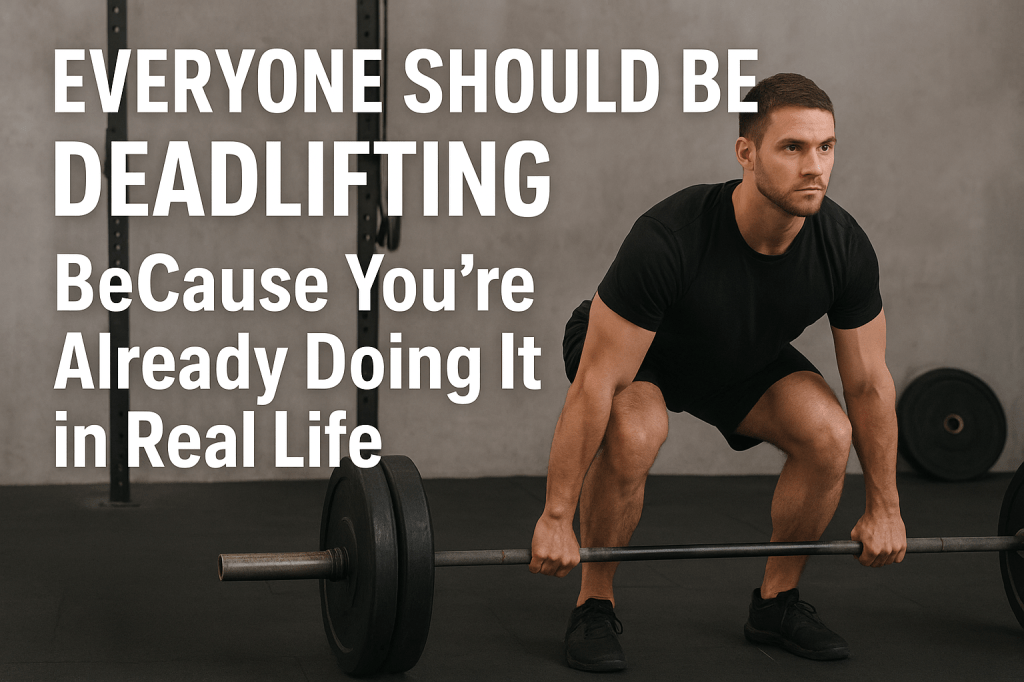
If you’ve ever watched someone curl, press, or sprint on the treadmill and wondered, “What’s the point?” you’re not alone. The truth is: most of us are already deadlifting in real life, even when we don’t call it that. The gym should be where we train those same movement patterns. We should include the deadlift. This helps us move better, stay injury-free, and feel stronger in everyday tasks.
Why Deadlifting Matters in Real Life
Every day, you’re probably performing a version of a deadlift without realizing it. I deadlift my three-year-old every time I pick her up. I deadlifted the trash out of the can earlier today. Then, I deadlifted a case of water from the floor to the counter. A deadlift movement is literally what the name implies. It involves lifting something that isn’t in motion off the floor and moving it somewhere else. Whether that’s your kid in your arms or a case of water from the ground, it’s the same pattern.
That’s why deadlifting is one of the most functional and beneficial movements you can train. It builds real-world strength, reinforces safe lifting mechanics, and helps prevent injury in everyday life. It’s not just about lifting weights—it’s about preparing your body to handle life’s constant “pick this up” moments.
Deadlifting improves posture and spine health by teaching you how to brace and move with control. It also builds grip strength—something you’ll use for everything from carrying groceries to opening jars. It recruits nearly every major muscle group, such as glutes, hamstrings, quads, back, and core. Therefore, it’s one of the most efficient total-body exercises you can do.
Common Myths (and the Truths)
Myth 1: Deadlifts destroy your back.
Truth: When performed correctly, deadlifts actually strengthen your back and protect it. It’s poor form—not the lift—that leads to injury.
Myth 2: Deadlifts are only for powerlifters.
Truth: This movement benefits everyone. You don’t have to lift massive weights to reap the rewards. The goal is control, consistency, and confidence in the movement pattern.
Myth 3: You must go heavy every session.
Truth: Strength develops over time. Progress comes from gradual increases—whether in weight, reps, or precision of form.
How to Start Deadlifting Safely
Start with mastering the hip hinge. Practice moving your hips back while keeping your spine neutral—use a dowel or broomstick for feedback. Once you feel comfortable, choose a variation that suits you.
The conventional deadlift builds overall strength and targets the full posterior chain. The Romanian deadlift (RDL) emphasizes the hamstrings and teaches control through the hinge. The trap bar deadlift is often more forgiving on the lower back and great for beginners.
Form always comes first. Keep your feet hip-width apart, grip the bar just outside your legs, and keep it close to your shins. Brace your core as if preparing to take a punch. Let your hips and shoulders rise together. Ensure the bar travels in a straight path.
The Real-World Payoff
When you train your deadlift, you’re not just chasing numbers—you’re training to move better in the real world. You’ll notice that lifting your child, carrying groceries, or moving furniture feels easier. Your posture improves. Your back feels stronger. You’ll gain a sense of control and stability in how you move every day.
Final Thoughts
If you’re not deadlifting yet, it’s time to start. You’re already doing it in daily life—so why not learn to do it better? The deadlift is one of the most practical, empowering, and functional exercises you can add to your routine. Start light, focus on form, and build gradually. Your future self—and your back—will thank you.
 Exercise Science Journey
Leave a comment